Mobile Innovations Reshaping Bonus Allocation for Table Game Players Under Nordic Oversight
Skriven av Avery Schmitz · 2026-08-23

Mobile Innovations Reshaping Bonus Allocation for Table Game Players Under Nordic Oversight
Regulatory bodies across Sweden, Denmark, Norway and Finland have tightened oversight of online table games in recent years, and mobile platforms now serve as the primary channel where bonus structures must align with those rules. Data from national licensing records shows that operators deliver real-time bonus calculations directly through smartphone applications, which track player activity and adjust offers for games such as blackjack, roulette and poker. These systems rely on geofencing, identity verification and spending-limit modules that update every few seconds, ensuring compliance without interrupting gameplay.
Core Regulatory Requirements for Table Game Bonuses
Nordic authorities require that any promotional credit tied to table games carries clear wagering conditions and cannot exceed specified percentages of deposits. The Swedish Spelinspektionen maintains a public register of approved bonus formats, while the Danish Gambling Authority publishes quarterly compliance summaries that list how mobile operators segment bonuses between slots and table products. Observers note that these distinctions matter because table games carry lower house edges, so bonus allocation formulas must prevent rapid conversion into cash withdrawals. In practice, apps enforce separate ledgers for each game category and transmit data to regulators through encrypted APIs.
Mobile Technology Driving Allocation Changes
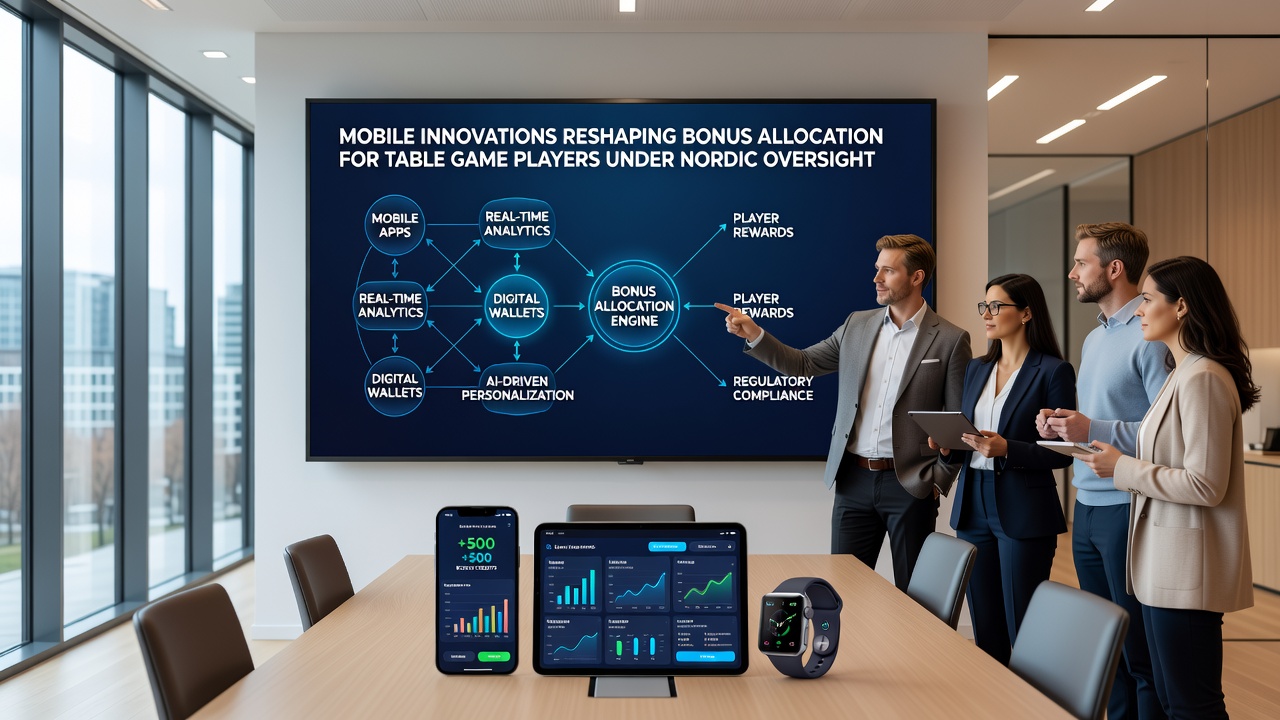
Developers have introduced machine-learning models that calculate personalized bonus values based on session length, average bet size and historical play patterns, all processed on the device before syncing with central servers. One application released in early 2025 uses on-device inference to flag when a player approaches a regulatory deposit cap, then offers a time-limited table-game credit that resets automatically once the cap lifts. Another system employs blockchain timestamps to record every bonus trigger, giving regulators an immutable audit trail that reduces manual reporting. These tools operate within the same bandwidth constraints as standard mobile networks, allowing operators to serve players in remote Nordic regions without latency spikes.
August 2026 Platform Updates and Their Impact
Scheduled code releases planned for August 2026 will introduce dynamic bonus multipliers that scale with table-game volatility rather than fixed percentages. Internal testing documents indicate that these multipliers activate only after players complete a set number of hands, a safeguard designed to meet Nordic responsible-gaming thresholds. The updates also embed direct links to national self-exclusion registries, so any player who activates a cooling-off period sees all pending table-game bonuses frozen instantly across linked operator accounts. Industry reports suggest the changes will standardize data fields exchanged between operators and oversight bodies, cutting reconciliation time by roughly forty percent.
Case Examples from Licensed Operators
One Nordic-licensed operator integrated a mobile wallet feature that allocates bonus funds proportionally across blackjack and roulette tables based on live table limits. When a player switches tables mid-session the app recalculates remaining wagering requirements and displays the updated figure in a persistent header. A separate firm piloted augmented-reality overlays that highlight eligible bonus bets on virtual felt, reducing player confusion about which wagers count toward release conditions. Both implementations underwent third-party audits before deployment, with results submitted to the relevant national authority.
Data Exchange Standards and Security Measures
Secure transmission protocols now require that every bonus transaction carry a digital signature verified against keys issued by the licensing jurisdiction. Research published by the Technical University of Denmark outlines how these signatures prevent retroactive alteration of allocation records, a feature that supports cross-border audits when players hold accounts in multiple Nordic markets. Mobile applications also incorporate biometric prompts before large bonus redemptions, adding another layer that aligns with guidelines on player protection issued by the Norwegian Directorate of Health.
Future Integration with Emerging Standards
Work continues on unified data schemas that would let operators submit a single compliance file covering all Nordic markets rather than separate reports for each country. Early prototypes tested in 2025 demonstrated that such schemas can embed mobile-specific fields for location accuracy and device fingerprinting. As these standards mature, bonus allocation engines will gain the ability to apply jurisdiction-specific rules automatically, further reducing manual oversight while maintaining the transparency demanded by regulators.
Conclusion
Mobile innovations continue to reshape how bonus credits reach table-game players while satisfying the detailed requirements set by Nordic authorities. Real-time calculation engines, secure audit trails and scheduled platform upgrades scheduled for August 2026 illustrate the ongoing technical response to regulatory expectations. Operators that maintain these systems report smoother licensing renewals and fewer compliance queries, outcomes that follow directly from the documented alignment between mobile architecture and oversight protocols.